Punta Gorda Isles Sailboat vs Power Boat: What Costs More
August 20, 2026
August 20, 2026
A new owner in Punta Gorda Isles opens their first November tax bill and finds a line item they never budgeted for: a canal maintenance assessment, separate from property tax, funding seawall repair and dredging for the whole district. It is not small. In 2022, the City of Punta Gorda raised the PGI assessment from $650 to $950 per single-family parcel in a single year, a 46 percent jump that drew residents to a budget hearing to ask why nobody warned them. Burnt Store Isles, the newer canal community just south of PGI, saw a smaller increase that same year, from $560 to $860. The city's explanation was straightforward: PGI's seawalls date to the mid-1960s through 1980, while BSI's are two decades younger, so PGI simply has more linear feet approaching the end of its structural life.
That gap in age is the same gap that explains almost everything else buyers get wrong about pricing in these canals, including the biggest one: paying a premium for "sailboat access" in a section of PGI where almost nobody keeps a sailboat.
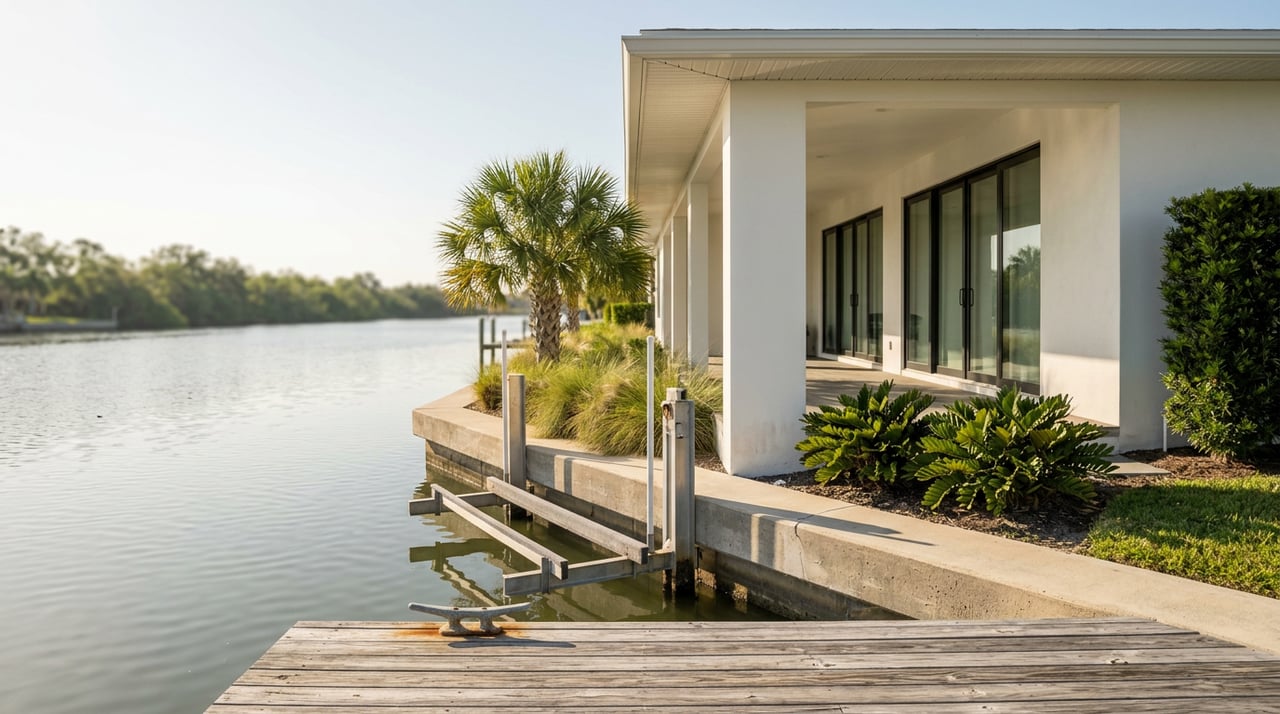
Punta Gorda Isles is not one canal system. It is four, each built at a different time, each with a different relationship to Charlotte Harbor, and each carrying a different price tag for reasons that have less to do with what a buyer will actually do with the water and more to do with what the label has meant for sixty years.
The pattern that keeps showing up in local listings and closed sales is this: waterfront lots marketed as sailboat access, meaning no fixed bridge stands between the dock and open water, consistently command more than lots in the power boat section, even though most boats on these canals are not sailboats at all. Center consoles, pontoons, and flybridge cruisers make up the bulk of the traffic, and the vast majority of them clear a standard fixed bridge without issue. The premium survives anyway. It has become a shorthand for prestige more than a functional requirement for most owners, and once you see that, you can decide whether you want to pay for the label or shop the section that actually matches your boat.
Here is how the four sections break down:
| PGI Section | Location | Bridge situation | Typical ride to open water |
|---|---|---|---|
| Original Sailboat Section | North of West Marion Avenue, closest to the Peace River | No fixed bridges | About 5 to 10 minutes |
| Power Boat Section | Along West Marion Avenue, near Fishermen's Village | Fixed bridges, published clearances in the 13 to 14 foot range | Under 15 minutes for most boats, but taller sailboats and flybridge cruisers cannot clear |
| Bird Section | South of Aqui Esta Drive, streets named for birds | No fixed bridges once through Buckley's Pass | Before April 2020, some rides ran 75 minutes or more via Ponce de Leon Inlet. After Buckley's Pass opened, about 15 minutes |
| South Sailboat Section | Reached via Buckley's Pass into Alligator Creek | No fixed bridges | Roughly 15 to 30 minutes depending on exact location |
The Bird Section row is worth sitting with, because it shows how much a single infrastructure decision can change the math. For decades, homeowners in that pocket of PGI had some of the longest boat rides in the entire canal system despite technically having no fixed bridge. Every trip to the harbor meant looping through the Ponce de Leon Inlet the long way. The City of Punta Gorda had discussed a shortcut for more than a decade before it finally broke ground, and when the channel opened to the public on April 3, 2020, it collapsed those rides from well over an hour to about 15 minutes. The city named the passage after the late Capt. John "Jay" Buckley, who had pushed for the project alongside the Punta Gorda Boaters' Alliance long before it became reality. As one member of the Punta Gorda Isles Civic Association put it at the time, the logic behind the project was simple:
"The faster you can get out, the more desirable it is for them to own that property."
That sentence is the whole thesis in miniature. Desirability in these canals tracks travel time and bridge access, not boat type. Buckley's Pass didn't add a bridge or remove one. It just gave the Bird Section the same kind of fast exit that the Original Sailboat Section had enjoyed since the 1960s, and property values in that pocket reflect it now the way the rest of PGI always has.
Ask three sources what a Punta Gorda Isles home costs right now and you will get three different answers, and that is itself the point. Redfin's data through December 2025 put the median PGI sale price at $499,000, down 21.9 percent year over year, with homes taking a median of 81 days to sell. Other market reports from earlier in 2026 place the PGI median closer to $510,000 to $570,000, and by June 2026, Realtor.com data cited elsewhere showed PGI's median listing price near $599,000, with price per square foot running about $294 compared to $186 in Deep Creek, an inland Punta Gorda neighborhood without canal access.
None of those numbers are wrong. They are measuring different slices of a neighborhood that is not one market. A condo in the Power Boat Section and a custom sailboat-access home on a wide tip lot in the Original Sailboat Section both get folded into "Punta Gorda Isles" in a portal search, and the resulting median tells you almost nothing about what your specific dollar amount actually buys.
The individual sales make the spread easier to see. Redfin's closed-sale data from around the same period shows a condo at 3256 White Ibis Court selling for $189,500 in 34 days at full asking price, while a four-bedroom waterfront home on La Mancha Court sold for $745,000 after sitting on the market 277 days, closing 3 percent under its original list. A third home on Messina Drive took 328 days to sell for $780,000. The entry-level product moves fast. The high-end waterfront sits, gets negotiated, and eventually sells at a discount from where it started. If you are shopping this neighborhood by median price alone, you are averaging two very different buyer pools into one number that describes neither of them well.
Bridge access and boat ride times get discussed constantly among boaters here. The canal maintenance assessment gets discussed far less, and it shows up on every parcel in both districts regardless of which section you buy into.
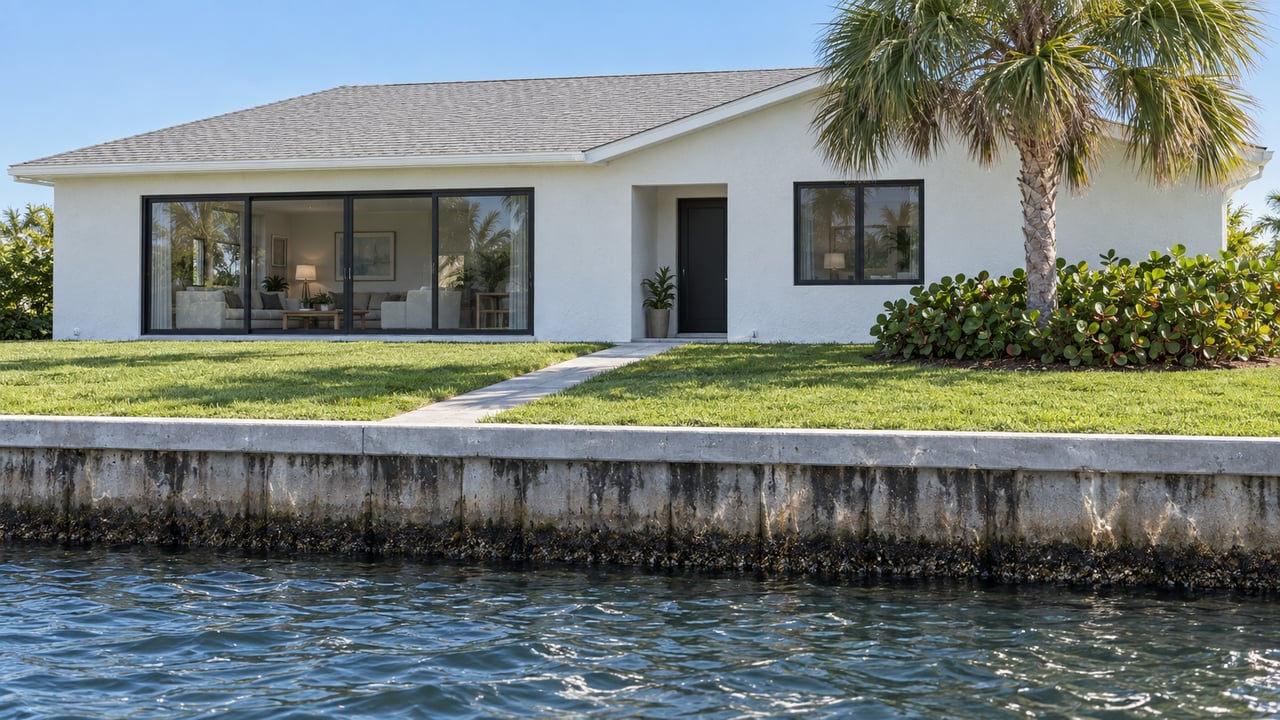
The city's canal maintenance program covers seawall inspection, replacement, and dredging across roughly 91 miles of seawall and 45 miles of canals in PGI, and about 18 miles of seawall and 9 miles of canals in the smaller, newer BSI district. Both districts fund this through a non-ad valorem special assessment, meaning it lands on your November tax bill as a separate charge from property tax, tied to a fiscal year that runs October through September. Because PGI's infrastructure is older, its assessment has historically run higher and moved up faster than BSI's, and the 2022 increase is documented in local reporting that quoted city officials defending the jump as a response to seawall age, not mismanagement.
Before writing an offer on any PGI or BSI canal home, it is worth asking a few direct questions:
None of this shows up in listing photos, and it rarely comes up until closing paperwork.
Section names and bridge clearances are a starting point, not a guarantee. Charted depths shift, tidal datums matter, and the only clearance that counts is the one measured against your specific boat's air draft, beam, and draft. We've written a separate step-by-step guide to verifying sailboat access before you buy that walks through gathering your boat's exact measurements, tracing the route on a nautical chart, and confirming bridge and tidal information before you rely on a listing description. Use that alongside the section map above, and you'll know not just what a house costs, but what it actually gets you on the water.
Does every home in the Power Boat Section have a fixed bridge? Yes, at least one, with clearances generally in the 13 to 14 foot range. Most powerboats clear these without issue, but sailboats with fixed masts and some flybridge cruisers cannot.
Did Buckley's Pass change values across all of PGI, or just the Bird Section? The direct benefit was concentrated in the Bird Section, the area the assessment for the project covered. The rest of PGI's boat ride times were unaffected, since the pass simply gave the southern pocket of the neighborhood a shortcut the northern sections already had.
Is the canal maintenance assessment the same every year? No. It is set annually through the city budget process and can rise, as it did sharply in 2022, when seawall age and repair costs outpaced the prior rate.
The instinct to chase "sailboat access" is understandable. It has been the shorthand for the best water in Punta Gorda Isles for sixty years. But shorthand is exactly what it is. If your boat is a pontoon or a center console, the Power Boat Section may get you to open water just as fast, for less money, with a maintenance assessment that's identical regardless of which section you choose. If you actually own or plan to own a sailboat, the premium buys you something real, and the section map above tells you which one gets you there fastest.
Our team at Get Your Florida Life spends a lot of time walking these canals section by section with buyers who are relocating from out of state and don't yet know a Bird Section listing from a Power Boat one. If you want that kind of local read before you write an offer, Start Your Punta Gorda Search and let's talk about which stretch of water actually fits the boat you own.
Have a Florida home you want to sell? Work with someone who knows what buyers look for and markets directly to them.
2200 Kings Hwy, 3L PMB A1007 Port Charlotte, FL, 33980