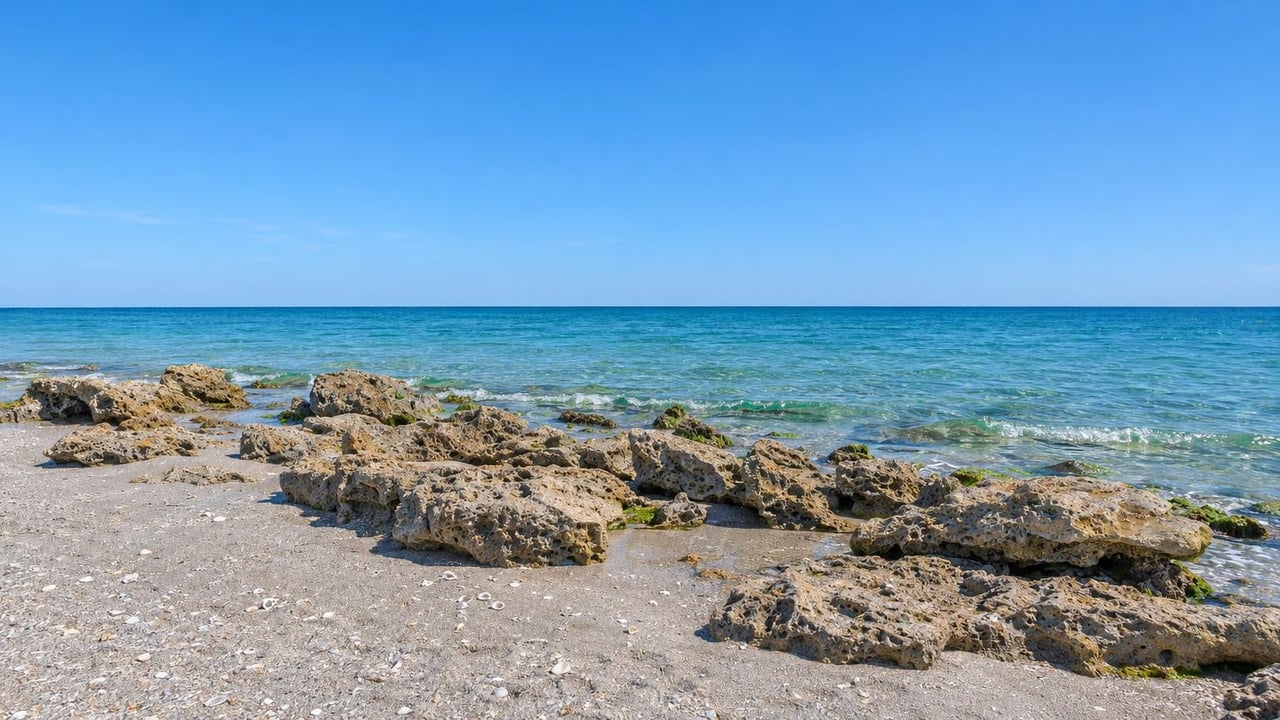
Hunting Shark Teeth in Venice Now That the Beach Has New Sand
November 26, 2026
In March 2005, a reporter from The Ledger watched a family of Canadian visitors work the water off Venice Beach. One man stood thigh-deep in 65-degree Gulf water and pulled up mounds of wet sand and broken shell with a long-handled wire scoop. His wife and sister sorted the piles at the waterline, tossing the phosphate pebbles and keeping the small black teeth. After two hours they had about 20 teeth, most about half an inch long, and they were happy with that. A veteran hunter told the paper the same effort would have turned up four times as many teeth ten years earlier, before the city began pumping in sand from offshore.
That article came out just as Venice was starting its second beach renourishment. This winter is the first tooth season after the fourth one. The pattern the Ledger described in 2005 is the most useful thing a Venice tooth hunter can know right now. New sand goes on top of the layer where teeth turn up, and the stretch of shore the project skipped gets more valuable for it. In Venice that stretch is Caspersen Beach, and you can't drive to it at the moment.
The U.S. Army Corps of Engineers ran the Venice Shore Protection Project 2026, and Weeks Marine, Inc. did the work. The project covered about 3.2 miles of shoreline, from just south of the Venice Inlet to just south of the Venice Fishing Pier. The construction contract was $27,495,000, all of it federally funded. The sand came from an offshore borrow area about 11 nautical miles southwest of the project, off the coast of Englewood. According to the City of Venice, dredging and sand placement ended on August 16, after nearly 620,000 cubic yards of sand had gone onto the beach.
The city's FAQ puts the affected beaches between the Humphris Park South Jetty and South Brohard Park, including Venice Beach and Service Club Park. Those are the beaches most of us mean when we tell visiting family we'll go look for teeth.
Venice has done this before. WFLA covered the October completion ceremony and listed the city's renourishments in 1995, 2005, 2015 and now 2026. At the ceremony, Mayor Nick Pachota remembered a time from his childhood when "the water actually came up to the middle of the road" on the Esplanade South. The city says the project replaces sand lost since the 2015 nourishment and restores beach width.
In the same 2005 Ledger story, then-Mayor Dean Calamaras, himself an avid fossil hunter, said it plainly: "There are fewer shark teeth because we put 200 feet of sand where there was none before. You still find them on the beach. You just don't find them in such high numbers." He remembered the beach before the first project as exposed rock and sediment with very little sand. A Sarasota beach renourishment consultant quoted in the piece put the fossil-bearing sediment 15 to 20 feet down, below the sand.
That reporting covers the projects of 1996 and 2005. The geology underneath is the same today. In a WWSB beginner's guide filmed on Venice Beach this September, the Shark Frenzy and Fossil Frenzy team explained that Venice sits on the Peace River Formation, a submerged layer full of prehistoric marine life, and that waves and tides wear that old seabed down and wash teeth into the surf. Teeth will keep arriving with the waves.
On the renourished stretch, follow the WWSB guide's technique. Look for the dense, dark shell beds and coarse sediment right where the waves break. Scoop into the wet shell hash and let the Gulf water rinse the fine sand through the mesh. Then scan what's left for glossy enamel, triangular points and root shapes. Venice teeth are jet black, slate gray or deep charcoal, not the bright white of a modern shark's tooth. The same guide says hunters regularly find lemon, bull, tiger, mako and snaggletooth teeth, and the lucky ones find stingray mouth plates or a chip of megalodon.
The sifter itself is a Venice invention. The father and son behind Shark Frenzy and Fossil Frenzy co-invented the floating Shark Tooth Sifter in 2013, and their shops will identify your finds. If you come home with a bag of dark triangles you can't put a name to, take them to one of the shops.
In 2005, the Ledger reported that one beach near Venice hadn't been renourished and gave tooth hunters better odds: Caspersen Beach. The 2026 project stopped just south of South Brohard Park, so Caspersen is outside it again.
Getting there is different from what longtime residents remember. Sarasota County says the Harbor Drive access to Caspersen Beach Park at 4100 Harbor Drive S. washed out during the 2024 storm season. The restrooms, vehicle parking and playground are closed until repairs are made. The park is open to people on foot and on bikes, from South Brohard Park or from the Venetian Waterway Park trail at the City of Venice Festival Grounds, and its hours are 6 a.m. to 10 p.m.
The bike route is a good way in. Sarasota County describes the west side of the Venetian Waterway Park trail as about five paved miles along the west side of the Intracoastal Waterway, running south to Caspersen Beach Park. Plan for the closed amenities. There are no restrooms at Caspersen right now, so pack water and a sifter you can carry. If you go in from South Brohard Park at 1900 Harbor Drive S., the city lists restrooms, showers and a beach boardwalk there.
The long-term plan for the road is still being decided. The Venice Gondolier reported that the options include realigning the road, building a costly bridge, or having no vehicle access at all. The decision is expected to take several years, and FEMA funding depends on choosing a permanent fix that reduces future losses. On October 12, Venice City Council added support for reopening Caspersen Beach to its 2027 state legislative priorities. The city manager said the meeting to present those priorities to the local legislative delegation is scheduled for December 9.
The renourishment is almost finished. The city's latest update, posted November 12, said rock remediation in the central part of the project area was the only task left and that the contractor would resume once a specialized piece of equipment arrived. It also said part of the parking lot near the Venice Fishing Pier remained closed. Rock remediation started south of the pier on August 25 and closed Brohard Paw Park's beach access to people and dogs while the work went on. That beach access closed again for tilling on October 7. If you take a dog along for a tooth hunt, check the city's project page before you go.
The pier is fully open. The City of Venice lists the Venice Fishing Pier as open 24 hours a day, seven days a week. Its hurricane-damaged T-end was repaired for $410,000 by Tampa Bay Marine Inc. WWSB reported the full reopening on September 29, 2025. Sharky's on the Pier is holding its Fall Family Fishing Tournament this Saturday, November 28. With part of the pier lot still closed, expect parking there to be tight.
Saturday is also the 50th annual Venice Holiday Parade, "Golden Traditions." It steps off downtown at 6:30 p.m., and pre-parade activities start as early as 2 p.m. That leaves time for a morning on the beach with a sifter, a long lunch, and a walk downtown for the parade. Venice City Hall and other city buildings are closed Thursday and Friday, November 26 and 27, for Thanksgiving. Thursday garbage customers get their pickup Monday, November 30, and their recycling and yard waste Thursday, December 3.
The next big date on the shark tooth calendar is in April. The official site lists the 2027 Venice Sharks Tooth Festival for April 10 and 11.
If you'd like a home near the Venetian Waterway trail with an easy bike ride to Caspersen, or just want to hear more about how Venice's beaches are changing, Team GYFL would love to help. Browse our Venice neighborhood guide and say hello. Bring your sifter questions too. We're always happy to talk about this stretch of coast.
Have a Florida home you want to sell? Work with someone who knows what buyers look for and markets directly to them.
2200 Kings Hwy, 3L PMB A1007 Port Charlotte, FL, 33980